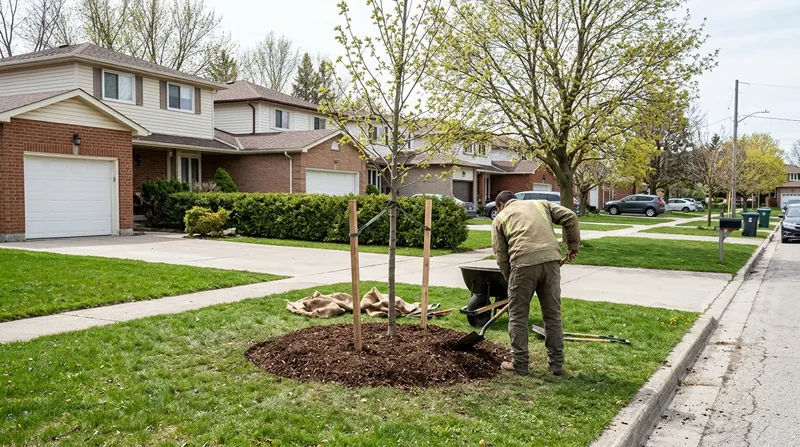




Choosing the right tree for a Barrie yard starts long before a shovel hits the ground. Our ISA Certified Arborists assess your soil, available space, sun exposure and the species already growing on your street before recommending anything. The goal is simple: the right tree in the right place, planted at the correct depth, and given a start that lets it establish through in Barrie and the surrounding area winters. Whether you are replacing an ash lost to the emerald ash borer, adding a sugar maple to a ravine lot, or moving a mature specimen before a renovation, we handle the planting and the transplanting with a full root ball. Call (249) 800-0391 for a free estimate, or review our complete pricing grid before you book.
Why planting and transplanting done properly matters in the Barrie area
A tree planted too deep or in the wrong soil will struggle for years before it fails. Barrie sits on heavy in Barrie and the surrounding area clay in many neighbourhoods, with pockets of sandier ground near the lake and along ravine edges. Species choice has to match that reality, and so does planting depth. Root flare placement is the single most common defect we correct on young trees, and it is entirely preventable at planting time.
Transplanting adds a second challenge: moving a tree with a root ball large enough to keep it alive. A tree that has been in the ground for more than a few seasons needs proper equipment and the right season to survive the move.
- We test drainage and compaction before recommending a species for your yard.
- We match native and hardy species to the light and space your property offers.
- We set the root flare at grade, never below it, and backfill with the native soil.
- We stake only when the site is windy or the root ball is unstable.
- We water and mulch at installation and leave you a simple care schedule.
Every planting is documented so you know what went in, where, and how to water it through the first two summers.
Key info: A 2-metre Norway spruce planted in heavy clay in Springwater needs a wider planting hole and a raised mound to drain. The same tree on sandy ground near a ravine lot in Barrie can go straight into the native soil. Species and site decide the method, not a standard formula.
For municipal guidance on tree by-laws and private property rules, see the City of Barrie website.
How our crews plant and transplant
We start with a site visit, not a catalogue. Our arborist looks at soil, drainage, overhead clearance, the location of your private service entrance, and the space the tree will need at maturity. From there we recommend species and a planting plan, then schedule the work for the right season.
- We mark the planting location and check for underground services before digging.
- We dig a hole two to three times the width of the root ball and no deeper than its height.
- We set the tree so the root flare sits at or slightly above grade.
- We backfill with native soil, water thoroughly, and mulch to an 8-centimetre depth, keeping mulch off the trunk.
- We stake only where wind or root ball instability requires it, and we remove the stakes after one growing season.
- For transplants, we root-prune in advance where possible, then lift with a full root ball and move it in dormancy.
You receive a written care note covering watering volume and frequency for the first two years.
Key info: A 6-centimetre caliper sugar maple transplanted in Oro-Medonte in late October needs a root ball roughly 1.5 metres wide. Moving it in July would risk losing the tree. Season and root ball size are not negotiable.
If a tree has to come out before a new one goes in, our tree removal service coordinates the removal, stump grinding and replanting in one visit sequence.
Planting and transplanting methods compared
Not every tree goes in the same way. The method depends on the size of the specimen, the season, and the access to your yard. Tight backyards reachable only through a standard gate in Barrie neighbourhoods call for smaller stock and hand tools. Ravine lots with steep access need a different plan entirely.
| Method | Description | Context |
|---|---|---|
| Bare-root planting | Young stock planted without soil around the roots, in early spring before bud break. | Best for small yards and tight gate access in Barrie neighbourhoods. |
| Container or potted stock | Tree grown in a nursery pot, planted with the root ball intact. | Suits most residential plantings from spring through early fall. |
| Wire basket and burlap | Larger caliper tree with a formed root ball, lifted and set in place. | Common for street tree replacements and front-yard plantings. |
| Transplant with full root ball | Established tree root-pruned in advance, lifted and moved in dormancy. | Used when a mature specimen must move for a renovation or lot change. |
We choose the method after seeing the site, not before. The right approach protects the tree and your budget.
What regulates planting and transplanting across the Barrie area
Planting a new tree on private property rarely needs approval, but the surrounding rules still matter. The City of Barrie may require a permit for a private tree removal, and that application is normally supported by an arborist report. Rules and thresholds differ from one municipality to the next across the Barrie area, so we check the local requirement before any removal that clears space for a new planting.
Near private electrical service entrances, approach distances must be respected. Our crews work only on the customer's private service entrance and never on the public distribution network, which belongs to your local utility or Hydro One. A tree touching the public lines is referred to your local utility or Hydro One, not handled by us.
Disposal is part of the plan. Brush and small wood from clearing or transplanting go through our chipper, and usable firewood can be left on site or hauled away. For larger clearing work before a planting, see our lot clearing service.
Where a removal is part of the project, an arborist report documents the tree's condition and supports the municipal application. We prepare that report in-house with our ISA Certified Arborists.
Choosing species for Northwest yards and ravine lots
Species selection is where most planting budgets are won or lost. A silver maple will outgrow a small Northwest backyard in fifteen years. A black locust tolerates poor, dry soil but spreads aggressively. A sugar maple wants room and decent soil, and rewards you with fall colour for decades.
We shortlist species by soil, light, space at maturity and your tolerance for maintenance. Native oaks and maples support local insects and birds. Norway spruce and cedar work well as windbreaks and privacy screens. Birch needs cool, moist ground and struggles in hot, exposed spots.
If your property already has a mature canopy, our tree pruning service keeps it healthy while new stock establishes underneath.
Season, watering and the first two years
Early spring and early fall are the best windows for planting in the Barrie area. The soil is workable, moisture is reliable, and roots have time to establish before the ground freezes. Transplanting established trees is a dormancy job, late fall to late winter, when the tree is not pushing growth.
Watering is the single biggest factor in survival. Newly planted trees need slow, deep watering through the first two summers, especially on sandy ground or exposed sites. Mulch helps, but it does not replace water.
Key info: A newly planted 5-centimetre caliper red oak in Barrie typically needs about 40 litres of water per week through July and August of its first two years. Skipping that schedule is the most common reason a young tree fails.
Our crews return for a follow-up check in the first season to confirm the tree is settling correctly and the stakes, if any, are still doing their job.
When a planting needs a removal first
Many planting projects start with a removal. An ash killed by the emerald ash borer, a storm-damaged birch, or a maple crowding a service entrance often has to come out before a new tree goes in. We sequence the work so the removal, stump grinding and planting happen in a logical order and the site is left clean.
Stump grinding removes the obstacle below grade so the new tree is not planted over old roots. Our stump grinding service handles that step, and we coordinate the timing with the planting schedule.
If a tree is dead or damaged and needs to come down quickly, our emergency tree removal service responds year-round, including after ice storms and summer windstorms.
Working with an ISA Certified Arborist on your planting plan
Our arborists are on staff, not contracted per job. That means the person who assesses your site is the same person who signs off on the planting plan and the follow-up. We have been working in Barrie and the surrounding municipalities since 2013.
We carry full insurance and can provide a certificate of insurance on request. For a free estimate, call (249) 800-0391 or use our contact page. We will walk the property, recommend species and placement, and give you a written estimate before any work begins.
Prices Tree Planting & Transplanting in Barrie — Indicative pricing
| Service | Price | Details |
|---|---|---|
| Planting of young stock (bare-root or potted) | From $275 | Includes site check, planting hole, backfill, mulch and care note |
| Planting of larger caliper trees (wire basket) | From $475 | Includes lifting equipment, staking where needed and first watering |
| Transplant of an established tree with a full root ball | From $850 | Root pruning in advance, lifting, transport and replanting |
| Removal and replanting in one visit | From $1,150 | Removal, stump grinding and new planting sequenced together |
| Site visit and written planting plan | Free | Species recommendation, placement and care schedule |
| Travel | Included | In Barrie and the surrounding municipalities |
Indicative prices; free, personalized estimate within 24h at (249) 800-0391.